Doksy
Digital Passport
Nomenclature and Geography
Category: City / Municipality
Summary
About the place: Doksy is a town in the southern part of Česká Lípa District in the Liberec Region of the Czech Republic, situated on the shores of Lake Mácha (Máchovo jezero) amid picturesque forested rolling hills. It serves as a prominent summer resort and tourist hub of the Mácha region, closely linked to the romantic legacy of poet Karel Hynek Mácha.
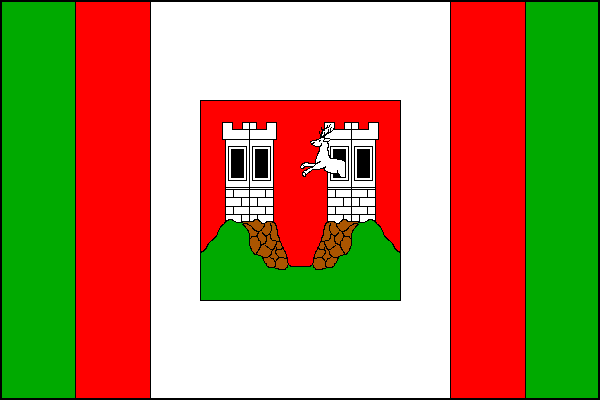
Flag Description: The flag consists of five vertical stripes: green, red, white, red, and green in a width ratio of 1:1:4:1:1. Centered on the broad white stripe is a red square field with a width equal to half the hoist width. Within it, on a green lawn, rise two green knolls, rocky and brown on their inner sides; each knoll is topped by a white square tower facing with its edge to the front, masoned in the lower half, with a three-crenelated battlement and two black rectangular windows side by side. Leaping toward the hoist from the tower nearer the fly edge of the field is a white stag. The flag's hoist-to-fly ratio is 2:3.
Symbolism: The flag's design is derived directly from the town's historical coat of arms, documented on a municipal seal dating back to 1630. The central motif—a stag (German: Hirsch) leaping from a tower atop hills (Berg)—forms a classic piece of canting arms (heraldic pun) illustrating the town's historical German name, Hirschberg. The rocky wooded hills and green color symbolize the surrounding forested landscape, the towers denote municipal status and defense, and the red, white, and green colors reflect the traditional tinctures of the town's emblem.
Flag Description: The flag consists of five vertical stripes: green, red, white, red, and green in a width ratio of 1:1:4:1:1. Centered on the broad white stripe is a red square field with a width equal to half the hoist width. Within it, on a green lawn, rise two green knolls, rocky and brown on their inner sides; each knoll is topped by a white square tower facing with its edge to the front, masoned in the lower half, with a three-crenelated battlement and two black rectangular windows side by side. Leaping toward the hoist from the tower nearer the fly edge of the field is a white stag. The flag's hoist-to-fly ratio is 2:3.
Symbolism: The flag's design is derived directly from the town's historical coat of arms, documented on a municipal seal dating back to 1630. The central motif—a stag (German: Hirsch) leaping from a tower atop hills (Berg)—forms a classic piece of canting arms (heraldic pun) illustrating the town's historical German name, Hirschberg. The rocky wooded hills and green color symbolize the surrounding forested landscape, the towers denote municipal status and defense, and the red, white, and green colors reflect the traditional tinctures of the town's emblem.
Statistics
Area
74.96 km²
Population
5,119