Környe
Digital Passport
Nomenclature and Geography
Category: City / Municipality
Summary
About the place: Környe is a village located in Komárom-Esztergom County, Hungary, near the town of Tatabánya. Situated near the Vértes Mountains, it boasts a rich history dating back to Roman times.
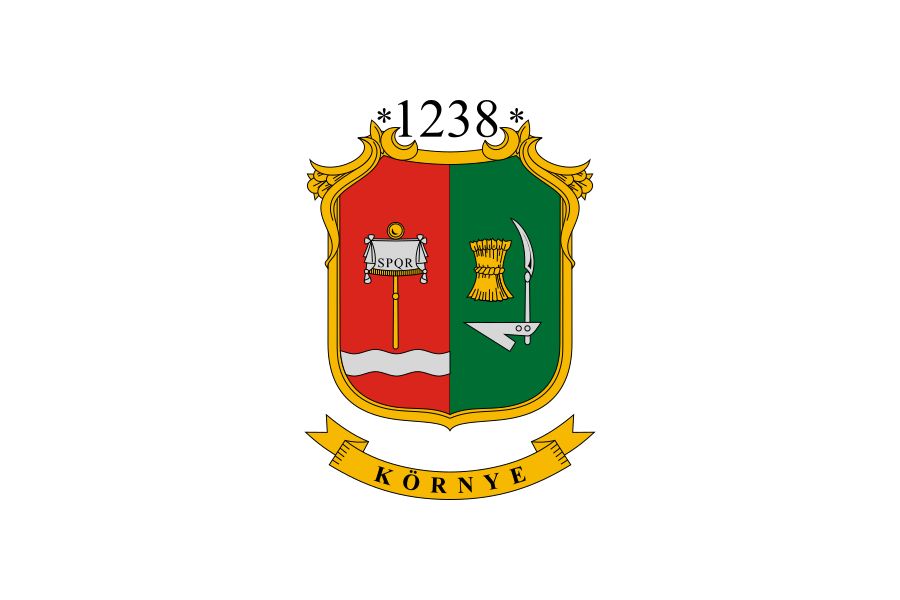
Flag Description: The flag of Környe consists of a white rectangular field bearing the municipal coat of arms in the center, enclosed by an ornate golden frame. The shield is vertically divided: the left field (viewer's left) is red, featuring a silver and gold Roman standard with the inscription 'SPQR' standing above a silver wavy bar at the base. The right field is green, displaying a golden sheaf of wheat, a silver coulter, and a plowshare. Above the shield is the year '*1238*', and below it is a yellow ribbon with the black inscription 'KÖRNYE'.
Symbolism: The coat of arms on the flag reflects the village's rich history and agricultural heritage. The Roman standard with the inscription 'SPQR' and the wavy bar refer to the ancient Roman fortress and settlement along the Által-ér stream. The sheaf of wheat, coulter, and plowshare symbolize traditional agriculture and the fertility of the land. The year 1238 marks the first written mention of the settlement.
Statistics
Area
45.16 km²
Population
4,474