Leme, São Paulo
Digital Passport
Nomenclature and Geography
Category: City / Municipality
Summary
About the place: Leme is a municipality in the state of São Paulo in the Southeast region of Brazil. Officially established in 1895, it serves as an important regional agricultural and industrial center.
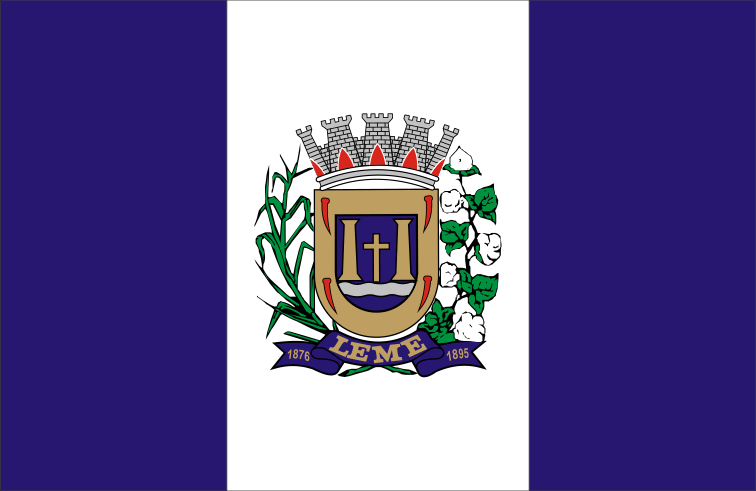
Flag Description: The flag consists of three vertical bands: blue on the hoist side, white in the middle, and blue on the fly side. In the center of the wider white stripe is the municipal coat of arms. The coat of arms features a gold shield with a smaller blue inner shield displaying two golden towers with a cross between them over a wavy base. The shield is surmounted by a silver mural crown with red gates and flanked by a sugarcane stalk on the left from the observer's perspective and a cotton branch on the right. Below the shield is a blue ribbon inscribed with the city name 'LEME' and the years '1876' and '1895'.
Symbolism: The blue color symbolizes justice, nobility, and the sky, while white represents peace, purity, and the religious faith of the inhabitants. The towers and cross in the coat of arms refer to local history and faith, while the sugarcane and cotton branches highlight the traditional agricultural crops that drove the municipality's settlement and development. The dates on the ribbon mark the founding of the initial settlement (1876) and its official political emancipation (1895).
Statistics
Area
402.87 km²
Population
98,986