Árpás
Digital Passport
Nomenclature and Geography
Category: City / Municipality
Summary
About the place: Árpás is a village in Győr-Moson-Sopron County in northwestern Hungary. It is situated in the Little Hungarian Plain along the right bank of the Rába River.
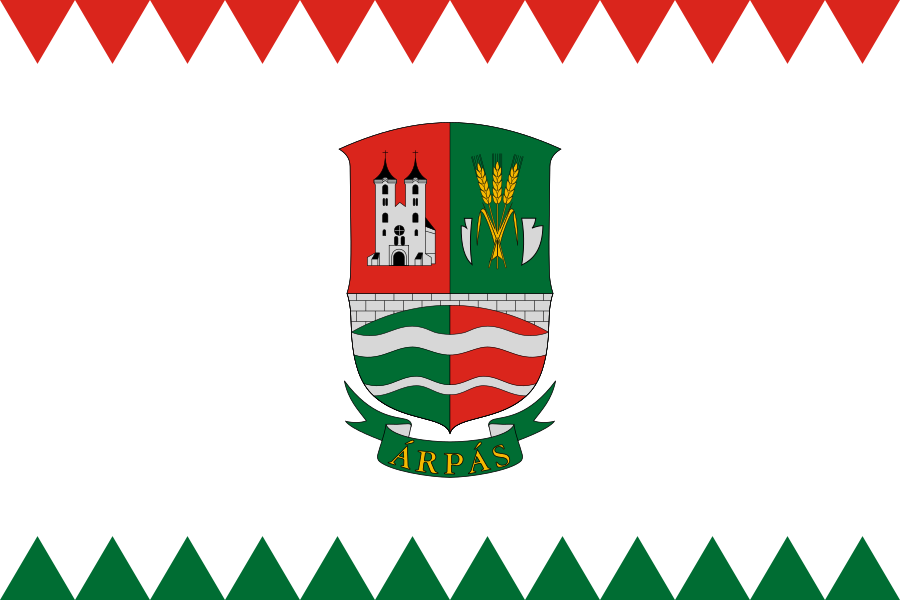
Flag Description: The flag features a white field bordered along the top edge by a row of twelve red triangles pointing downward and along the bottom edge by a row of twelve green triangles pointing upward. Centered on the field is the municipal coat of arms above a green ribbon bearing the yellow inscription ÁRPÁS. The shield is divided horizontally by a silver masonry bridge with a single arch into upper and lower halves, both of which are further divided vertically. The upper hoist red field displays a white two-towered church, while the upper fly green field shows three crossed yellow wheat ears flanked by a silver coulter and plowshare. The lower half is divided vertically into green and red and is charged with two silver wavy bars.
Symbolism: The red, white, and green colors reflect the Hungarian national colors, arranged as a traditional triangular border along the upper and lower edges. The two-towered church in the coat of arms depicts the historic 13th-century Romanesque Church of Saint James, originally part of a Premonstratensian provostry. The wheat ears together with the plowshare and coulter symbolize the agricultural heritage of the village and the fertility of the surrounding plain. The masonry bridge and two wavy bars represent the historic crossing over the Rába River and local waterways.
Statistics
Area
14.26 km²
Population
265