Pély
Digital Passport
Nomenclature and Geography
Category: City / Municipality
Summary
About the place: Pély is a village in Heves County, Hungary, located in the Heves District. It lies in the southern part of the county near the Tisza River and Lake Tisza.
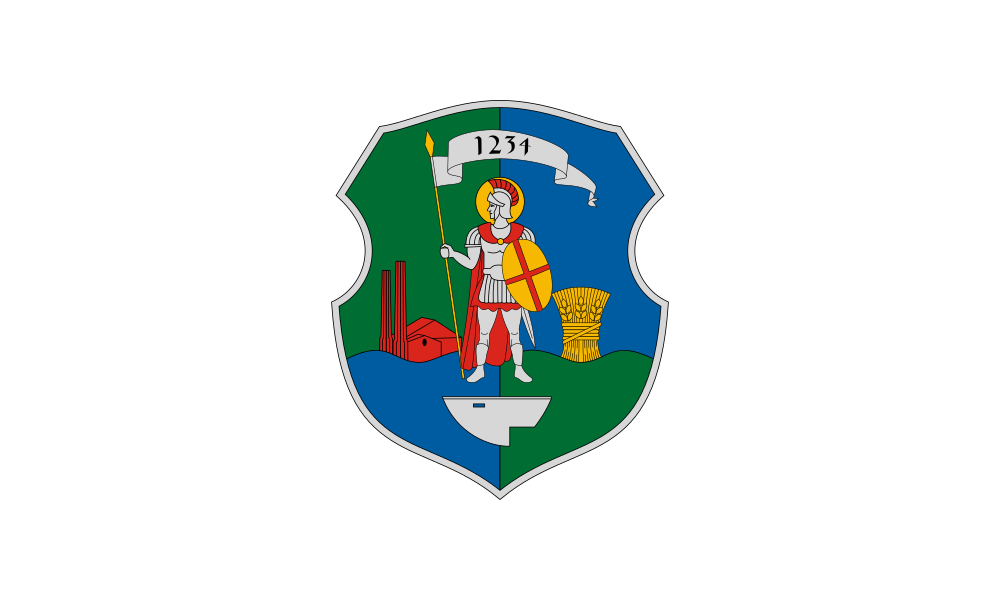
Flag Description: The flag consists of a white field charged in the center with the coat of arms of Pély. The shield is divided into green and blue fields. Standing in the center is Saint Florian in Roman armor with a red cape, holding a spear with a banner and an oval shield with a red cross. Above him is a silver ribbon displaying the year 1234. In the upper hoist division (upper left from the viewer's perspective), a red industrial building with two chimneys stands above blue water. In the upper fly division (upper right), a golden sheaf of wheat is set on a blue field. In the base of the shield, a plowshare is depicted.
Symbolism: The white flag background features the municipal coat of arms, centered on Saint Florian, the patron saint of fire protection. The scroll bearing the year 1234 marks the earliest written mention of the village. The golden wheat sheaf and plowshare symbolize the community's agricultural heritage, while the industrial building with chimneys and the water reference local industry and the proximity to the Tisza River.
Statistics
Area
47.30 km²
Population
1,282