São Miguel do Iguaçu
Digital Passport
Nomenclature and Geography
Category: City / Municipality
Summary
About the place: São Miguel do Iguaçu is a municipality located in the western part of the state of Paraná, Brazil. It is situated near the borders with Paraguay and Argentina within the Foz do Iguaçu microregion.
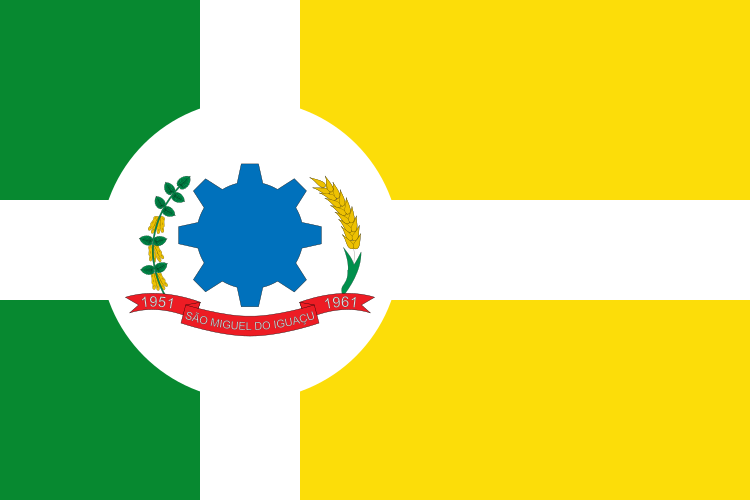
Flag Description: The flag features an off-center white cross (Scandinavian/Nordic cross style shifted toward the hoist) dividing the field into four rectangles: two green on the hoist side and two yellow on the fly side. At the intersection of the cross arms is a large white circular disc bearing the municipal emblem. The emblem consists of a central blue cogwheel flanked by a soy branch on the left (viewer's perspective) and a wheat ear on the right, above a red ribbon displaying the text 'SÃO MIGUEL DO IGUAÇU' flanked by the years '1951' and '1961'.
Symbolism: The green and yellow colors reflect Brazil's national colors, representing agriculture and natural wealth. The white cross symbolizes Christian faith and peace. The central emblem highlights the municipality's economic pillars: the blue cogwheel represents industry and progress, while the soy branch and wheat ear symbolize agricultural production. The red ribbon bears the name of the municipality along with historic dates related to its settlement and emancipation.
Statistics
Area
851.30 km²
Population
29,122