Sirok
Digital Passport
Nomenclature and Geography
Category: City / Municipality
Summary
About the place: Sirok is a village in Heves County, Northern Hungary, situated in the Mátra mountain range near the Tarna River. It is famous for its dramatic medieval castle ruin perched atop a rocky hill overlooking the municipality.
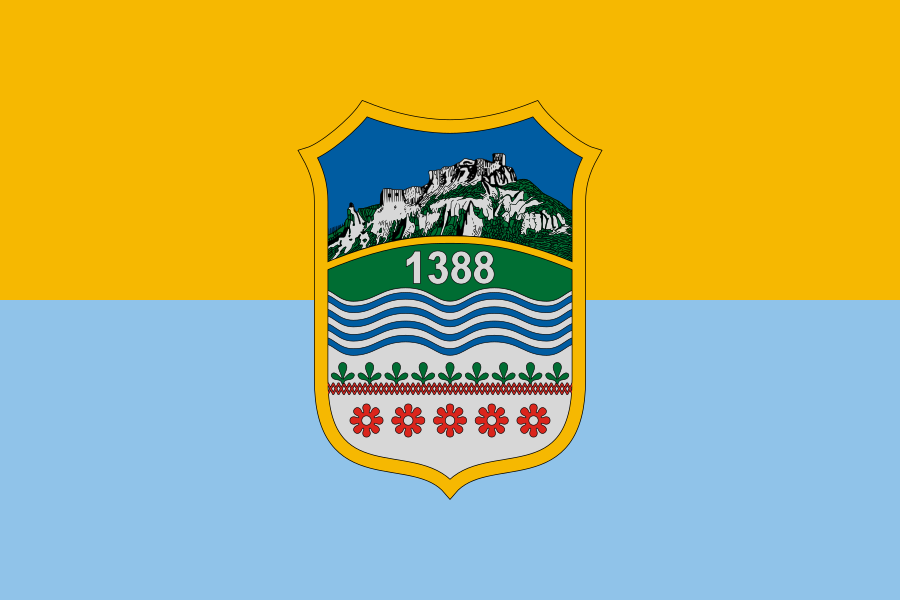
Flag Description: The flag of Sirok consists of a horizontal bicolour of yellow on top and light blue on the bottom. In the centre of the flag is the municipal coat of arms edged with a yellow border. The shield features the rocky hill with Sirok Castle in the upper blue field, the year 1388 in a green band beneath it, wavy blue bars representing the local river in a silver field, and green botanical motifs, a red ornamental band, and five red flowers at the bottom.
Symbolism: The yellow and light blue colours of the flag are derived from the municipal shield. The upper part of the coat of arms prominently features the historic Sirok Castle on its rocky crag. The year 1388 marks an important historical milestone in the written record of the village. The wavy lines symbolize the Tarna River, while the traditional floral and ornamental motifs at the bottom represent local folklore, natural heritage, and agriculture.
Statistics
Area
49.81 km²
Population
1,581