Zalaszántó
Digital Passport
Nomenclature and Geography
Category: City / Municipality
Summary
About the place: Zalaszántó is a village in Zala County in western Hungary, nestled in a scenic valley of the Keszthely Hills north of Lake Balaton. It is widely known for the monumental Buddhist Peace Stupa on Kovácsi Hill and the ruins of the medieval Tátika Castle.
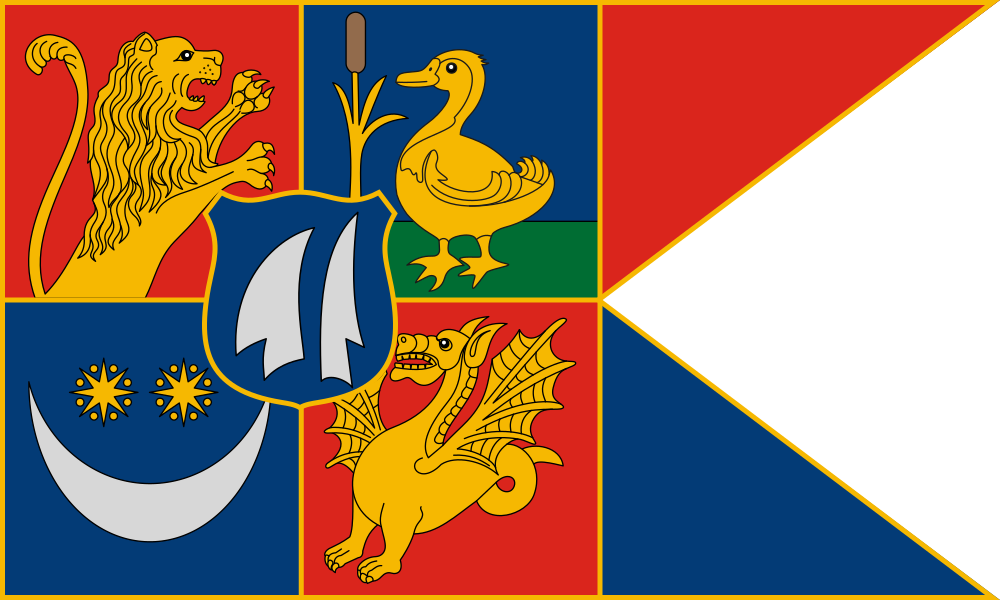
Flag Description: The flag of Zalaszántó consists of a quartered hoist section and a swallow-tailed fly with two triangular tails, with the entire flag and its internal divisions bordered by a narrow yellow fimbriation. The upper hoist quarter is red bearing a demi-lion in yellow facing the fly, while the lower hoist quarter is blue with a white crescent horns upward surmounted by two yellow twelve-pointed stars. The upper middle quarter is blue with a green base on which stands a yellow duck facing the hoist in front of a yellow reed with a brown head; the lower middle quarter is red with a seated winged yellow dragon facing the hoist. Over the center of the quartering is a yellow-bordered blue inescutcheon charged with two upright white ploughshares facing the hoist. The upper fly tail is red and the lower fly tail is blue.
Symbolism: The flag design is derived from the historical municipal coat of arms and reflects both the noble history of the estate and the local natural environment. The two ploughshares on the central escutcheon commemorate the traditional agricultural heritage of the village and its historic seal. The lion and the dragon refer to the noble families that once ruled the area, notably the Pethő family, as well as local dragon legends associated with the nearby Tátika Castle. The duck and the reed symbolize the rich streams and wetlands of the Kovácsi valley, while the crescent and stars represent traditional Hungarian heraldic charges. Red, blue, and yellow lend the banner a ceremonial historical character.
Statistics
Area
37.73 km²
Population
943